Paris RER
 The Paris RER (or Réseau Express Régional) is the Paris commuter rail system connecting central Paris with the suburbs.
Many tourists who use the Métro are not familiar with the Paris RER. However, the Paris RER is easy to use and we have found that there are at least three instances in which it can be useful to Paris tourists.
First, a little general information about the Paris RER.
- There are 5 Paris RER lines, identified by the letters A through E.
- Planning a trip on the Paris RER is a lot like planning one on the Métro, and there are even many stations where you can make a "correspondence" between the RER and Métro (for example, Saint-Michel and Gare de Lyon).
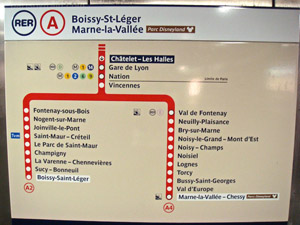
- Unlike metro lines, Paris RER lines split as they go out into the suburbs.
- The split RER lines are designated by numbers after the line's letter identification. For example, in the general direction of Charles de Gaulle Airport, there is an RER B3 line and an RER B5 line.
- The Paris RER C line is the most complicated with 7 tentacles (C5 goes to the Château de Versailles).
- If in doubt, consult an RER map in the station.
- Not all RER trains stop at all stations.
- Before you board an RER train, be sure it is going to stop at your destination.
- Be sure you are on the right platform for the line and direction you are headed.
- Know the complete designation of the line you need (e.g. B3) and be sure that it displayed on the front of the train as you watch it come into the station.
- Tickets
- You can use the same tickets that you use for the Paris Métro and Paris buses on the Paris RER as long as you remain in central Paris.
- If you use the RER to go to Versailles or Charles de Gaule Airport you will need a different ticket.
- Be sure to hold on to your ticket until you are completely out of the station.
- You will need to insert it into the ticket machine at the turnstile when leaving the station.
- Schedules
- The Paris RER trains all run on dedicated tracks, separate from the tracks used by the Métro.
- This means that there is frequent service, particularly if you are traveling within the central Paris area.
- At peak hours, trains on the A line run every 120 seconds.
The Paris RER, like the Métro, runs from about 5:30 am to about 1:00 am, but you must carefully note the time of the last trains at the stations you intend to use.
- When to use the Paris RER.
- We have found that as tourists, there are at least three occassions when the Paris RER is useful.
- As a substitute for the Paris Métro for travel along the Rive Gauche (Left Bank.)
- While the Métro Number 1 line runs along the Rive Droite (Right Bank), there is no comparable Métro line along the Rive Gauche.
- However, the Paris RER C line provides service from the Gare d'Austerlitz on the east, to the Champ de Mars Tour Eiffel on the west, with stops at St. Michel (Notre Dame and the Latin Quarter), Musée d'Orsay, Invalides and Pont de l'Alma in between.
- All RER C line trains make stops at these stations.
- Your Métro ticket is valid for the RER between these stations.
- The RER trains are more confortable than the Métro trains and make fewer stops.
- When traveling between Charles de Gaule Airport and central Paris.
- The Paris RER B3 line runs between Charles de Gaule Airport and central Paris, with a stop at the Gare du Nord.
- If your hotel is in the Rive Droite, take the train to the Châtelet Les Halles station where you can transfer to Métro lines 1, 4, 7, 11 or 14.
- If your hotel is in the Rive Gauche, take the train to the St. Michel Notre Dame RER station where you can transfer to the Métro 4 or10 lines.
- When visiting the Château de Versailles.
- The Paris RER C line runs from central Paris to the Château de Versailles.
- Board the train at the train at any of the following stations in central Paris: St. Michel, Musée d'Orsay, Invalides, Pont de l'Alma or Champs de Mars-Tour Eiffel.
- Make sure that the train is marked C5 in the direction of Versailles-Rive Gauche.
- The last stop is Versailles-Rive Gauche, where you get off the train. The Château is a 5 minute walk from the train station and is well marked.
- Be sure you don't get off at Viroflay-Rive Gauche; the name is similiar and is two stops before the Château.
- Also be sure that you don't go to Versailles Chantiers, which is on the C7 and C8 lines. If you get off at Versailles Chantiers, you have to take a bus from the train station to the Château. Only the C5 line goes directly to the Château.