Paris Buses
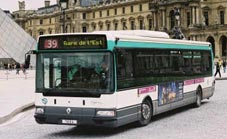 The Paris bus system nicely compliments the Paris Métro and Paris RER. Buses are not as fast as the Métro or the RER , and they run less often. However, Paris buses are clean and they provide a less claustrophobic ride with views of the Paris sites. Many newer buses are equipped with GPS, allowing estimated arrival information to be displayed at bus stops.
- Tickets
- A ticket for one bus ride costs €1.60.
- You can
buy your ticket from the bus driver (correct change required), or us a Métro T+ ticket.
- Transfers between bus lines are permitted if you use a Métro T+ ticket, as long as your last bus ride begins within one and one-half yours of the time that your first ride commenced. Just be sure to validate your ticket each time you change buses.
 Tickets purchased from the driver are marked "sans correspondance."
- They can not be used for travel on the Métro and do not permit transfer between buses.
- Weekly and monthly Métro passes can also be used to ride the bus.
Just swipe your Carte Navigo upon boarding the bus.
- Riding the Bus
 Locate the nearest bus stop for the line upon which you want to travel. Michelin has a handy pocket book showing all the Paris bus routes, or use this handy Interactive Paris Bus Map.
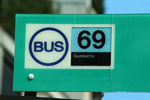
- In the street, the stops are shown by a bus shelter or a signpost indicating the name of the stop and the numbers of the buses stopping there. Some lines are fitted with a display showing the times of the next two buses.
- Wait at the stop until your bus arrives. Be sure to verify the bus number on the front of the bus. Each bus is clearly identified by its line number and direction above the front window, and its main stops shown along the side. Often serveral bus lines are served by the same stop.
- Unless there are many peoply waiting, signal the bus driver as the bus approaches that you want it to stop.
- Board the bus through the front door.
- As you board the bus, validate your ticket in the machine next to the driver, or swipe your Carte Navigo across the card reader.
- Follow your progress along the route by watching the stops and consulting the maps located throughout the bus.
- As the bus approaches your stop, press one of the red buttons fixed to the upright support rails. The sign "arrêt demandé" will display near the driver signaling that you want to disembark.
- Exit the bus using the rear exit.
- Useful Bus Lines for Tourists
- The 87 line runs from the Porte de Reuilly to the Champ de Mars. Its route takes it past the Bastille and through the left bank and St. Germain with stops at St. Sulpice, the Ecole Militaire and terminating at the Eiffel Tower.
- The 24 line runs along the right bank from Gare d'Austerlitz all the way to Concorde where it crosses the Seine and then passes the Madeleine.
- The 67 line originates at Pigalle and runs south to the Seine, then proceeds east to the Ile St. Louis where it crosses the Seine and continues south. This is an interesting way to return from the Sacre Coeur to central Paris. The walk down hill from the Sacre Coeur to Pigalle is an easy one.
- The Balabus is a special tourist bus operated by the RATP. It runs from the Gare de Lyon to the Grande Arche—Défense, but only on Sunday and holiday afternoons, and only from the first of April until the end of September. These big-windowed buses run every 15 to 25 minutes, and the
 entire trip takes about two hours one way. One bus or Métro T+ ticket will take you through most of central Paris. Three tickets are required to ride the entire route one way. You will recognize the bus and the route it follows by the Bb symbol on each bus's side and on sins posted along its route.